

Teens Spotlight Social Issues
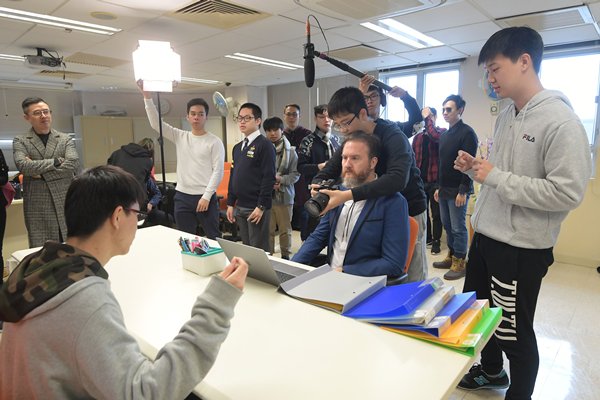
To encourage young people to appreciate the value of social inclusion, the Labour & Welfare Bureau’s Community Investment & Inclusion Fund has sponsored the FIGHT FOR SHOW project. Under the project, secondary school students create their own mini-dramas. Participants experience the film-making process from script writing to location shooting, while at the same time learn more about the social issues affecting people in Hong Kong.
Friendly match
About 30 students from Caritas St Joseph Secondary School were taught to play cricket by athlete Mohammad Osama and fellow ethnic minority youngsters. By the end of the day, they had not only learnt a new sport, but also about the culture of ethnic minorities living in Hong Kong.
“Playing cricket is fun and I can see how quick my reflexes are when hitting the ball. I am also here to communicate with ethnic minority students. I find they are very friendly and easy to talk to,” said student Kam Hung-wan.
The students are part of the FIGHT FOR SHOW project backed by the Community Investment & Inclusion Fund. They have been tasked with writing and producing a five-minute mini-drama based on the topic of racial harmony.
The project is supported by the Hong Kong Sheng Kung Hui Lady MacLehose Centre which provides diversified social services to ethnic minorities.
Through workshops, the students get to hear South Asian residents’ personal stories to use as research for their drama scripts.
“Integration starts with appreciation. So we hope that through this activity, they can start to appreciate the talent of South Asian students. And later on, when they head back to school, when they see each other, they at least have some conversation topics, like: ‘last time I played cricket, we saw you are very talented at it, can you tell me more about it?’ We want to start this kind of dialogue in the school.”
Cricketer Mohammad Osama was born in Hong Kong to Pakistani parents. He chose to share his story with the students to help enhance racial harmony.
“I want them to know more about our culture, like what we eat, what we drink, like what we play in sport,” he explained.
Edutainment concept
Students from 20 secondary schools have joined the FIGHT FOR SHOW project. Apart from racial inclusion, they can choose to produce mini-dramas in the context of disability, generational, technology and mental health inclusion.
Social enterprises and social welfare units organise workshops to provide the students with a better understanding of social inclusion before they even start writing a script for their films.
Students from Kwai Chung Methodist College have chosen mental inclusion as the topic for their mini-drama. One of the scenes portrays a job seeker with mental illness going for an interview.
“I interviewed people diagnosed with psychosis and their families. I got to know more about this mental disorder which has symptoms including delusions and hallucinations. They have their struggles and I hope to help them,” explained student Chan Chui-ying.
While fellow student Li Ming-yin said his view of mental illness changed while making the film.
“In the past, people thought those with mental illness were dangerous. After this workshop, I realised we must not discriminate against people with mental health issues but be more inclusive.”
Kwai Chung Methodist College Vice Principal Cheng Wing-wah said the project has opened the students’ eyes to social issues.
“Film-making is a way to express our thoughts. More importantly, the students will become aware of those in need and of people living with psychosis after taking part in this project.”
The students are responsible for the entire film-making process. They make up the production team including the director, cameraman, lighting engineer and sound engineer.
Broadening horizons
FIGHT FOR SHOW is jointly organised by Newzpire Limited and Active Concept. Newzpire Founder Earnest Li hopes the project will enable youngsters to better appreciate social inclusion issues, while at the same time build up their own resilience to change.
“We make use of popular culture to motivate young people to create a story, but the stories have to be based on a real story of some cases. So the participants have to act like a reporter, they have to go outside to understand the community and the specific topics, for example mental health and minorities, so they can have some evidence or supporting information to develop their story ideas. They can learn more from this process.”
The students’ mini-dramas will be showcased at roadshows and some of their work will be entered into local and international film festivals.
AI Powers Solo Startup Success
Agentic artificial intelligence (AI) is revolutionising the way entrepreneurs operate. Jeffrey Yang, formerly a con... Read more
Lab Advances Chinese Medicine Tests
Lu Rong, or velvet antler, is a highly valued Chinese medicinal material. According to the Chinese Pharmacopoeia, only... Read more
District Governance: Audible Upgrades Bring Safer Streets
Many pedestrians in Hong Kong might barely notice the steady rhythm of the “yellow box” mounted on traffic lights,... Read more
Firefighters Upgrade Gear And Training
A new generation of breathing apparatus has hit the frontlines of Hong Kong’s fire services, marking a significant t... Read more
Archiving HKs Cinematic Heritage
During the 1980s and 1990s, Hong Kong became established as a film-making powerhouse, earning the nickname “Hollywoo... Read more
Inspiring Youth In Cultural Heritage
A guitar shredding through neon streets and a delicate ink-wash mantis stepping across drawing paper are making an unl... Read more