

Smart Training Aids Rehabilitation
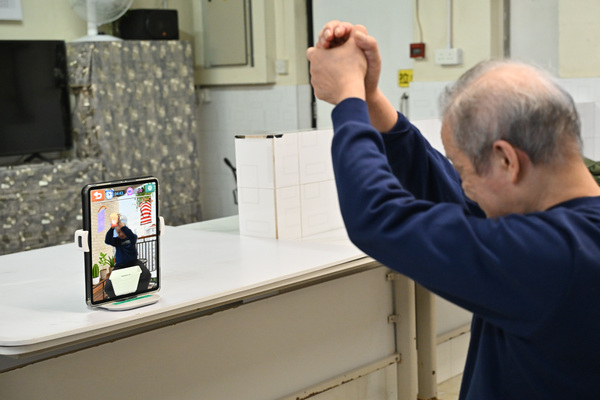
Seventy-year-old Mr Lau has been experiencing difficulty walking ever since he suffered a stroke last year. After having another stroke earlier this year, he is currently participating in the Pok Oi Hospital “Jockey Club Smart Geriatric Day Hospital Project”, which enables patients to undergo physiotherapy and occupational therapy at home or in their residential care homes for the elderly as part of their rehabilitation.
“I do exercises in the morning and afternoon,” he said. “I am quite hardworking because I want to recover soon. I have made progress with some of the activities, such as the dressing exercise, which trains my hand to lift higher. I used to feel pain when moving my right hand, but now I do not.”
He was also enthusiastic about a hiking routine that has enhanced his mobility. “At first, I needed to rest partway through, but now I can complete the entire route at once.”
Greater convenience
The programme allows elderly residents to undergo rehabilitation in familiar surroundings without the need for lengthy and tiring hospital trips. Lydia Au, a manager at the care home where Mr Lau resides, said the initiative helps residents to stay active and engaged during recovery.
“With the tablet provided by the hospital, they can now do the exercises any time they want and complete them on their own, which builds their confidence and sense of achievement. The programme was launched after an assessment confirmed our care home environment was suitable.”
Smart technologies
Pok Oi Hospital launched the “Jockey Club Smart Geriatric Day Hospital Project” with $14 million in funding from the Hong Kong Jockey Club Charities Trust, after being included on the Chief Executive’s Community Project List.
The funding supports the adoption of a smart training model that incorporates virtual reality, augmented reality and tele-rehabilitation technologies at the facility’s geriatric day hospital. The approach allows patients to train remotely without the need for frequent hospital visits.
Patients’ performance data are uploaded to a digital platform, enabling healthcare professionals to monitor progress and design personalised rehabilitation plans. Since the project was launched last year, approximately 350 patients have benefited, with the number of patients treated increasing by more than 20% year on year.
Fewer visits
Pok Oi Hospital Chief of Service of Department of Medicine & Geriatrics Dr Tony Chan said the programme mainly benefits elderly patients who experience mobility issues after hospitalisation.
“Our target patients include those recovering from stroke, hip fracture or dementia because they all require very intensive training.”
Previously, patients would undergo on-site training twice weekly for eight weeks, for a total of 16 hospital sessions. Under the new arrangement, they now only need to visit the hospital once a week from the fifth week onwards.
“Through these exercises, we hope to help them improve their mobility and cardiopulmonary function, as well as restore their ability to carry out daily activities independently.”
To make rehabilitation more enjoyable, cultural elements have been integrated into the exercises. “For example, some games feature mahjong or cartoon backgrounds of the Big Buddha on Lantau Island and the Tsing Ma Bridge to make the training sessions more interesting and engaging for elderly participants.”
Positive results
To evaluate the programme’s effectiveness, Pok Oi Hospital has collaborated with Lingnan University on a comprehensive study. Explaining its findings, Lingnan University School of Graduates Studies Senior Lecturer Chloe Siu said innovative tele-rehabilitation training achieves better results than traditional methods in several aspects.
“Older adults who joined the six-metre walking test walked significantly faster than those undergoing conventional therapy,” she said. In occupational therapy, meanwhile, patients showed clear improvements in hand fine motor functions and cognitive functions, as well as Instrumental Activities of Daily Living.
District Governance: Audible Upgrades Bring Safer Streets
Many pedestrians in Hong Kong might barely notice the steady rhythm of the “yellow box” mounted on traffic lights,... Read more
Firefighters Upgrade Gear And Training
A new generation of breathing apparatus has hit the frontlines of Hong Kong’s fire services, marking a significant t... Read more
Archiving HKs Cinematic Heritage
During the 1980s and 1990s, Hong Kong became established as a film-making powerhouse, earning the nickname “Hollywoo... Read more
Inspiring Youth In Cultural Heritage
A guitar shredding through neon streets and a delicate ink-wash mantis stepping across drawing paper are making an unl... Read more
Building Smarter, Faster In Hong Kong
Facing a chronic labour shortage and soaring construction costs, Hong Kong’s infrastructure sector is turning to adv... Read more