

Preserving HKs Fishing Tradition
Over the last two centuries Hong Kong has grown from a tiny fishing village to become one of Asia’s most dynamic cities.
Aquaculture has played an important role in this growth, with fishing providing food to nourish the local population and delight the many tourists who come to taste the exquisite seafood that makes up a large part of Cantonese cuisine.
However, Hong Kong’s traditional aquaculture industry has been fading in recent years with fewer people wanting to work in the sector.
So in 2014 the Government established the $500 million Sustainable Fisheries Development Fund to help the industry conduct research and development programmes to improve its operating environment and competitiveness.
Eight applications had been approved by last October and two of them were for fisheries-related eco-tourism projects.
Over the past two years, 110 fishermen have been trained to conduct eco-tours to promote aquaculture.
Sixty-year-old Choi Kam-shing is one of the eco-tour guides. He ran a fish farm with his family in Sha Tau Kok in the 1970s. With the business facing increasing challenges, he decided to instead work in construction to earn a living.
After retiring, he participated in an eco-tour guide training programme for fishermen sponsored by the fund.
The programme covered a wide range of topics, including the planning and design of tour programmes and routes, tour guide techniques, business management and administration, and marketing and promotion.
Fishermen’s friends
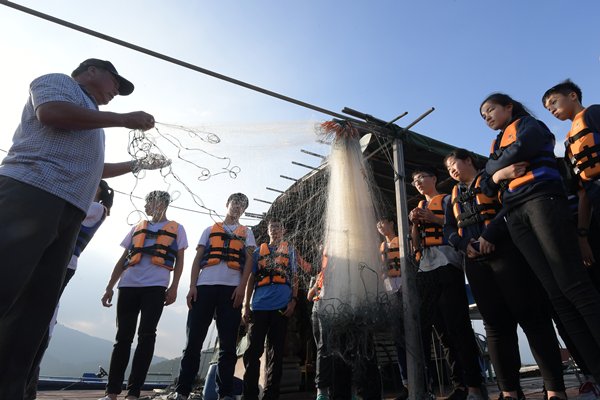
Mr Choi recently took 30 secondary school students out to sea. They visited the Hong Kong UNESCO Global Geopark and a fish farm to learn about the ecological characteristics and fishing history of Hong Kong’s northeastern waters.
The students were keen to learn how to catch fish and watched fishermen use different traditional fishing methods.
Mr Choi said he finds the job easy and enjoyable, explaining the equipment used by the trade, such as fishing nets and traps.
“I just share my personal experiences with the students. When they ask questions, I am happy to explain the details to them.
“Hong Kong was a fishing village. I am a fisherman. I hope to share aquaculture and fishermen’s hardships with the younger generation and educate them to treasure food.”
The students said they learned a lot about fishing and geography, and the difficulties faced by Hong Kong’s fishermen.
Preserving aquaculture
Non-profit making organisation the Environmental Association received more than $4 million from the fund and collaborated with local fisheries associations to conduct two eco-tour guide training programmes for fishermen.
The sponsorship lasts for two years. The eco-tours are held in northeastern and Cheung Chau waters.
The two programmes were launched in early 2016. The fishermen have held 240 free eco-tours so far, seeing 7,200 guests, most of them students.
Environmental Association Chief Executive Officer Yau Wing-kwong said they are fighting to conserve local aquaculture which is disappearing.
“The fishing industry makes an important contribution to Hong Kong in maintaining a steady supply of fresh marine produce to local consumers.
“These projects help fishermen pursue alternative ways to make a living, and we hope the scheme can promote aquaculture to young people.”
Mr Yau hopes to set up an online platform to promote the eco-tours, so they can continue to be run and to educate more youngsters about Hong Kong’s fishing industry.
AI Powers Solo Startup Success
Agentic artificial intelligence (AI) is revolutionising the way entrepreneurs operate. Jeffrey Yang, formerly a con... Read more
Lab Advances Chinese Medicine Tests
Lu Rong, or velvet antler, is a highly valued Chinese medicinal material. According to the Chinese Pharmacopoeia, only... Read more
District Governance: Audible Upgrades Bring Safer Streets
Many pedestrians in Hong Kong might barely notice the steady rhythm of the “yellow box” mounted on traffic lights,... Read more
Firefighters Upgrade Gear And Training
A new generation of breathing apparatus has hit the frontlines of Hong Kong’s fire services, marking a significant t... Read more
Archiving HKs Cinematic Heritage
During the 1980s and 1990s, Hong Kong became established as a film-making powerhouse, earning the nickname “Hollywoo... Read more
Inspiring Youth In Cultural Heritage
A guitar shredding through neon streets and a delicate ink-wash mantis stepping across drawing paper are making an unl... Read more