
Open Lab Boosts Textile Sustainability
With the increasing awareness of environmental protection, people nowadays want to live a greener lifestyle, which makes the sustainable development of the textile and fashion industry that much more of a concern.
In the view of this trend, The Hong Kong Research Institute of Textiles & Apparel (HKRITA) partnered with a non-profit organisation to establish Open Lab, a 20,000 sq ft research and development space. Open Lab aims to develop solutions for the textile, clothing and fashion industry to address climate change by showcasing innovative solutions, providing a collaborative platform and contributing to problem-solving and resource optimisation.
The large space features two primary components, the Fashion Future Lab and the Pilot Plant.
The lab is a modular research space used for focusing on emerging and forward-thinking ideas. Its modular design is beneficial for the development of flexible and adjustable solutions to meet the market’s fast-changing needs.
The HKRITA highlights that the lab serves as a platform for innovations to be developed into scalable applications, ensuring that research outcomes are market-ready.
Eco-friendly production
The first project presented in the Fashion Future Lab is “Farm-to-Garment”, which is a location-independent production line consisting of a hydroponics cotton farming system.
Traditional cotton farming is a soil-based cultivation method which relies on soil to provide nutrients and water to plants. It uses significant amount of water for irrigation. The lab utilises vertical hydroponic techniques, which is a soilless cultivation method where plants are grown in nutrient-rich water solutions.
Nutrients are directly delivered to the plant roots through water. This means that any water that is not absorbed by the plants can be reused, which significantly reduces water consumption, by up to 90%.
In addition, the hydroponic farming method provides controlled environments for continuous cropping. Plus, this type of farm can be located near cities, thus reducing carbon emissions from transportation.
At the same time, the small production line was set up at the lab to showcases its strength at being a one-stop shop for the textile industry.
After the cotton is harvested, it undergoes various processes, such as opening and drawing, to produce yarn for making clothes.
Efficient upcycling
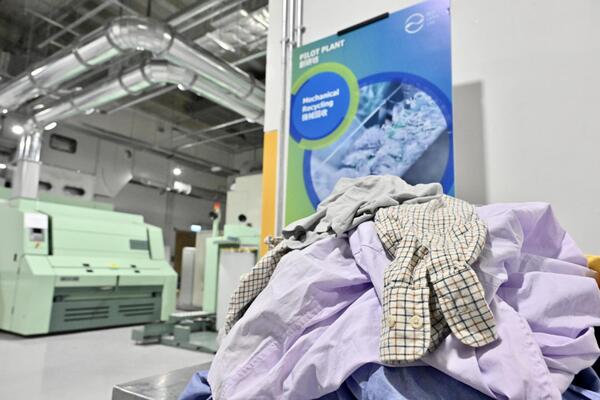
Another key feature of Open Lab is the Pilot Plant, which is an upcycling line featuring a smart garment sorting system for recycling, and the Green Machine 2.0, which separates mixed fibres.
The Hong Kong Research Institute of Textiles & Apparel Director (Business Development) Katherine Chan explained that cotton and polyester blended material is the most commonly used material in textile products.
“So we created Green Machine, using hydrothermal technology, to recover the polyester fibres in textiles. Then, we can do fibre-to-fibre recycling.
“The separated fibres are ready for re-spinning into new yarn products while the cellulose powders, decomposed from the cotton, can be reused for other purposes. As such, it forms a circular production system.”
With the upgraded Green Machine 2.0, the system has the capacity to recycle around a tonne of material daily. The research institute hopes that by demonstrating the feasibility and benefits of circular production, it can inspire and encourage the textiles and apparel industry to adopt similar practices to combat climate change.
Achieving sustainability
Open Lab officially opened in September. The HKRITA described the establishment of the lab as marking a significant milestone in leading the textile and fashion industry toward a more resilient future.
The organisation also stated that Open Lab drives collective efforts and further advancements in sustainable practices across the industry.
Support Bolsters Rising Sports
Passing, jumping and shooting. Anticipating, catching and counter-attacking. In a flash of lightning-fast movement, pl... Read more
AI Powers Solo Startup Success
Agentic artificial intelligence (AI) is revolutionising the way entrepreneurs operate. Jeffrey Yang, formerly a con... Read more
Lab Advances Chinese Medicine Tests
Lu Rong, or velvet antler, is a highly valued Chinese medicinal material. According to the Chinese Pharmacopoeia, only... Read more
District Governance: Audible Upgrades Bring Safer Streets
Many pedestrians in Hong Kong might barely notice the steady rhythm of the “yellow box” mounted on traffic lights,... Read more
Firefighters Upgrade Gear And Training
A new generation of breathing apparatus has hit the frontlines of Hong Kong’s fire services, marking a significant t... Read more
Archiving HKs Cinematic Heritage
During the 1980s and 1990s, Hong Kong became established as a film-making powerhouse, earning the nickname “Hollywoo... Read more