

Hydrogen Paves Low-carbon Future
Hydrogen energy is regarded as a low-carbon energy with development potential, as the world is striving to phase out fossil fuels and accelerate energy transition to tackle the challenge of climate change.
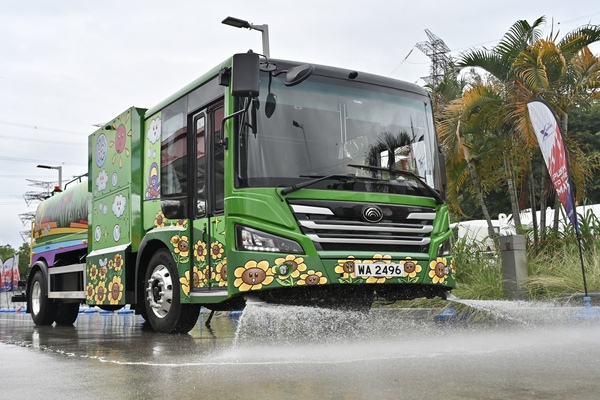
The Government unveiled a comprehensive strategy last year to support the development of hydrogen energy. One of the Government's initiatives in promoting hydrogen technology is the deployment of hydrogen fuel cell street washing vehicles in June, as well as the city’s first public hydrogen refuelling station.
Clear strategy
On the surface, they do not appear to be any different to traditional street washing vehicles, but they are actually new energy vehicles equipped with a hydrogen fuel cell, a power battery and an electric motor.
Compressed hydrogen is used to refuel the vehicle through a hydrogen receptacle and the hydrogen is stored in six cylinders within the vehicle. Refuelling takes approximately 15 minutes.
During operation, the hydrogen stored in the cylinders enters the hydrogen fuel cell, where it reacts chemically with oxygen from the air to generate electricity.
This design provides many advantages.
Convenient power
Electrical & Mechanical Services Department Engineer Rachel Li, who specialises in hydrogen fuel safety, explained that the electricity generated by hydrogen fuel cells powers the street washing vehicle and charges its batteries.
Unlike conventional fuel-powered vehicles, which emit exhaust gases, hydrogen fuel cell vehicles produce only water as a byproduct. Also, compared to pure electric vehicles, hydrogen fuel cell cars require fewer and smaller batteries, reducing future battery disposal concerns.
“Hydrogen energy, therefore, has significant potential for wider use in heavy-duty vehicles.”
Miss Li underlined that on the fuel cell street washing vehicle, there is a charging port next to the hydrogen receptacle which allows the power battery to be charged directly. That dual energy system optimises the use of hydrogen and electricity, maximising the advantages of new energy vehicles.
The street washing vehicles are currently utilised by the Food & Environmental Hygiene Department.
To ensure safety, hydrogen refuelling must always be operated by trained personnel.
Meticulous safetyAnother engineer from the department, Marco Lam explained that when the hydrogen street washing vehicle arrives at the filling bay, the driver will switch off the power supply. The refuelling operator will then place wheel stoppers to ensure it remains stationary.
Before refuelling, the operator will discharge static by touching an electrostatic discharge pole and connect the vehicle to an earthing device. They will then check for hydrogen leaks with a handheld detector, and once clear, connect the dispensing nozzle, secure it and begin refuelling.
The safety procedure ensures that hydrogen refuelling is conducted securely, minimising risks and safeguarding both operators and the environment.
AI Powers Solo Startup Success
Agentic artificial intelligence (AI) is revolutionising the way entrepreneurs operate. Jeffrey Yang, formerly a con... Read more
Lab Advances Chinese Medicine Tests
Lu Rong, or velvet antler, is a highly valued Chinese medicinal material. According to the Chinese Pharmacopoeia, only... Read more
District Governance: Audible Upgrades Bring Safer Streets
Many pedestrians in Hong Kong might barely notice the steady rhythm of the “yellow box” mounted on traffic lights,... Read more
Firefighters Upgrade Gear And Training
A new generation of breathing apparatus has hit the frontlines of Hong Kong’s fire services, marking a significant t... Read more
Archiving HKs Cinematic Heritage
During the 1980s and 1990s, Hong Kong became established as a film-making powerhouse, earning the nickname “Hollywoo... Read more
Inspiring Youth In Cultural Heritage
A guitar shredding through neon streets and a delicate ink-wash mantis stepping across drawing paper are making an unl... Read more