

HK Scientists Halt Disease Using AI
The use of artificial intelligence (AI) in the medical field is expanding rapidly, yielding significant breakthroughs.
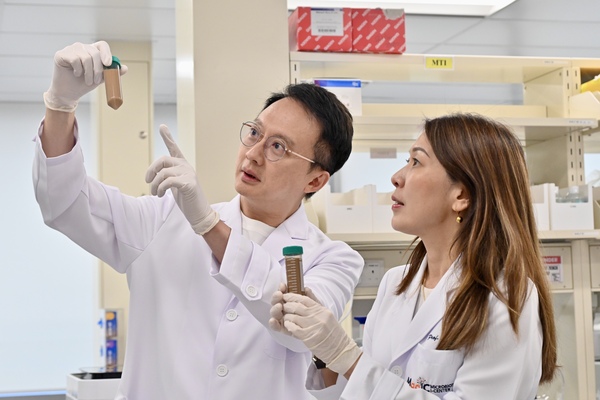
One example of this is the patented MOZAIC technology developed by the Chinese University of Hong Kong’s Microbiota I-Center with funding from InnoHK. This innovative solution combines faecal microbiota transplantation with AI, matching suitable microbiota to patients who have Clostridioides difficile infection (CDI).
Sixty-nine-year-old Chow Yee-mei recalled how she previously suffered with the disease: “I pooped over ten times a day, to the point that I could barely stand. It was not a sharp pain, but an unwell feeling that made you feel an urgent need to go to the toilet. And I was excreting blood. The entire toilet bowl was filled with blood. I cried every day.”
After seeking treatment from multiple doctors and spending hundreds of thousands of dollars on various antibiotics and other medications, without success, she finally recovered when she underwent MOZAIC.
The procedure involves selecting beneficial bacteria from the stools of healthy donors and injecting them into a patient’s gut via endoscope to rebuild their gut microbiome.
“I received the treatment at 8 or 9 o’clock in the morning,” said Ms Chow. “By 5 or 6 o’clock in the evening, I had stopped excreting blood. It was miraculous. It has now been over three years without any recurrence.”
Growing caseload
Over the past three years, Hong Kong has recorded more than 3,000 cases of CDI annually.
Microbiota I-Center Co-Director Prof Francis Chan, a gastroenterology and hepatology specialist, highlighted that the elderly, people with chronic illnesses or inflammatory bowel disease, and frequent users of antibiotics are all high-risk groups. Treatment with standard antibiotics is often ineffective, and the recurrence and mortality rates of the disease are as high as 35% and 40%, respectively.
“Long-term use of high-dose antibiotics wipes out the beneficial bacteria in the gut, allowing Clostridioides difficile to take hold," Prof Chan said. “With an ageing population and frequent antibiotic use for various infections, this problem is only set to grow.”
Microbial matching
In 2020, the Microbiota I-Center received InnoHK funding to establish one of Asia’s largest stool sample banks at the Hong Kong Science Park. Its samples are from people of all different ages, nationalities and health conditions. The centre’s MOZAIC solution draws on this bank of samples, leveraging AI to match patients with suitable microbiota.
“We make use of our huge bio-bank, collected over the years in Asia, including our Chinese population,” Prof Chan explained “Then, with the use of AI, we optimise the matching between the donor and the recipient. Therefore, our success rate, in terms of curing CDI, has approached over 90%.”
The centre has successfully applied this research in both public and private hospitals in Hong Kong, and the MOZAIC service has now been expanded to all Hospital Authority clusters. As of May this year, the authority had performed over 50 treatments, benefiting 48 patients.
Recently, the centre received a second round of InnoHK funding. This will allow it to operate for another five years and to expand its research into diagnosing autism and dementia through the gut microbiome, in addition to developing new drugs.
Research ecosystem
InnoHK’s two research clusters comprise 29 laboratories and centres focused on healthcare and AI & robotics technologies. They span collaborations with over 30 leading universities and research institutions worldwide and engage more than 2,500 local and international researchers working across nearly 500 research projects.
Commissioner for Innovation & Technology Ivan Lee said InnoHK is committed to helping research teams translate their findings into practical applications.
“Hong Kong’s university professors are outstanding researchers. By giving additional resources, we hope that our research teams can get a more focused platform to carry out their research and development (R&D).
“We expect that the complete ecosystem at the Science Park will help them establish networks and connect with potential investors, users of their R&D outcomes, as well as other business partners.”
Mr Lee described research outcomes to date as successful, with over 1,200 patents being granted or filed.
Firefighters Upgrade Gear And Training
A new generation of breathing apparatus has hit the frontlines of Hong Kong’s fire services, marking a significant t... Read more
Archiving HKs Cinematic Heritage
During the 1980s and 1990s, Hong Kong became established as a film-making powerhouse, earning the nickname “Hollywoo... Read more
Inspiring Youth In Cultural Heritage
A guitar shredding through neon streets and a delicate ink-wash mantis stepping across drawing paper are making an unl... Read more
Building Smarter, Faster In Hong Kong
Facing a chronic labour shortage and soaring construction costs, Hong Kong’s infrastructure sector is turning to adv... Read more
Media Interns Take Stage In Hunan
Navigating career options amid rapid transformation in the media industry presents a tough choice for communication st... Read more