

Green Transport Benefits Community
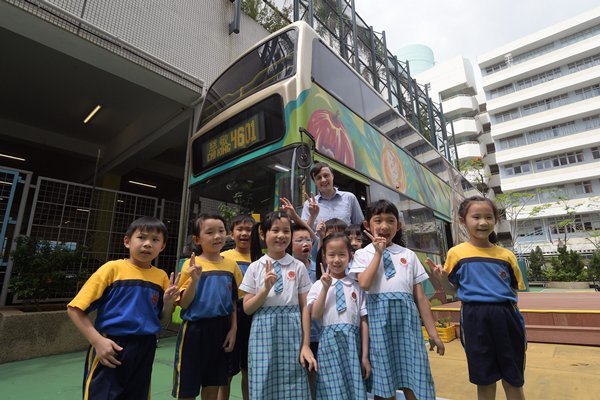
Not all retired double-decker buses need to be consigned to the scrapheap.
Under the Kowloon Motor Bus Company’s (KMB) Used & Retired Bus Programme, which was rolled out at the end of 2016, decommissioned single and double-decker buses are donated to schools and non-governmental organisations.
The Buddhist Chi King Primary School was one of the recipients of a retired bus which now enjoys a new lease of life as a library and learning centre.
The original features, such as the steering wheel and handrails were retained, providing children with an exciting new learning venue.
“It is beautiful and interesting. I can read more English books here and it helps me to learn English in a fun way,” noted primary student Emily Lau.
While fellow primary student Vicky Tsang said she enjoyed the relaxing atmosphere which encouraged her to read.
Up to now, 24 buses have been donated. The vehicles are converted into classrooms and interactive learning centres with various themes. Educators believe the revamped buses provide a unique and inspiring learning atmosphere.
Buddhist Chi King Primary School Principal Ivan Chong lauded the programme as interesting and educational.
“We make use of the recycled bus to build a reading bus for the whole school,” he said.
Green accolades
The Hong Kong Awards for Environmental Excellence, organised by the Environmental Campaign Committee in collaboration with the Environmental Protection Department and nine other organisations, encourages business and private sectors to jointly combat climate change.
At the 2018 awards, KMB’s advanced green technologies and innovative ideas were recognised with the Gold Award in the Transport & Logistics Sector.
The company’s award-winning green transport efforts include installing more solar panels on the roof of its double-deckers, marking a 40% increase in coverage area compared to the first generation of buses.
KMB Assistant Engineer Cheung Wan-yiu explained that the panels convert energy from the sun into electricity to power the ventilation system which cools down the bus while it is parked. The new cooling system also enables the bus to save fuel.
“When the engine is off, the power captured will drive the extraction motor located in the upper saloon. This can reduce the saloon temperature by an estimated 8 to 10 degrees Celsius. We also estimate the fuel consumption reduction is around 3%.”
Upgraded facilities
Not only buses are becoming greener. One of KMB’s most recent innovations is its Green Bus Shelter Scheme, through which the rooftops of hundreds of bus stops without any electrical installations would be equipped with solar panel systems to provide electrical power to support lights and anti-mosquito devices.
At pre-set times the system will switch on the lights and anti-mosquito device under the shelter so that passengers no longer need to wait in the dark.
The company has also set up its first solar bus stop pole featuring solar-powered bulbs with an auto-sensor, which means they automatically light up in the dark. Passengers can then obtain bus route information during the day and at night.
AI Powers Solo Startup Success
Agentic artificial intelligence (AI) is revolutionising the way entrepreneurs operate. Jeffrey Yang, formerly a con... Read more
Lab Advances Chinese Medicine Tests
Lu Rong, or velvet antler, is a highly valued Chinese medicinal material. According to the Chinese Pharmacopoeia, only... Read more
District Governance: Audible Upgrades Bring Safer Streets
Many pedestrians in Hong Kong might barely notice the steady rhythm of the “yellow box” mounted on traffic lights,... Read more
Firefighters Upgrade Gear And Training
A new generation of breathing apparatus has hit the frontlines of Hong Kong’s fire services, marking a significant t... Read more
Archiving HKs Cinematic Heritage
During the 1980s and 1990s, Hong Kong became established as a film-making powerhouse, earning the nickname “Hollywoo... Read more
Inspiring Youth In Cultural Heritage
A guitar shredding through neon streets and a delicate ink-wash mantis stepping across drawing paper are making an unl... Read more