

District Governance: Empowering Seniors Via Digital Literacy
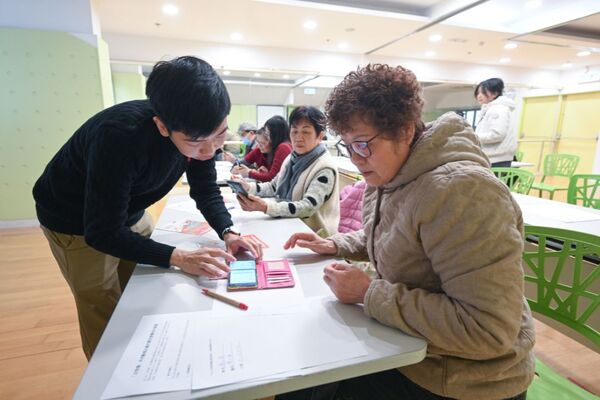
Some local seniors explain that entering the digital age and mastering everyday technology can be challenging for them.
“At our age, we are out of loop when it comes to modern technology,” said Mr Fung, who began using a smartphone just about two years ago.
He recalled an experience that he felt completely lost when he needed to register online for driving licence service.
“I hope to learn more, enabling me to do it by myself in the future,” he added.
The “Smart Silver” Digital Inclusion Programme for Elders is exactly tailor-made for seniors like Mr Fung to provide various avenues for them to become self-sufficient in using technology.
Encouraging integration
The Government is actively following up on various district issues to achieve practical benefits for the public. To help elderly individuals integrate into the digital era and enjoy the benefits of digital technologies, the Government announced in the 2024-25 Budget that the Social Innovation & Entrepreneurship Development Fund would allocate $100 million to subsidise non-governmental organisations (NGOs) to implement the digital inclusion programme, with an expectation of benefiting over 100,000 seniors.
Following an open invitation for proposals and evaluation, the fund has appointed 12 NGOs to carry out the programme.
Such organisations have established 40 regular and fixed-point community-based help desks across 18 districts, with at least two support points in each district. The help desks provide digital training and technical support to seniors aged 60 and above, particularly singleton or doubleton elders living in the old districts and public housing.
Elderly-convenient courses
Mrs Chung, who lives near one of the community-based help desks, praised the programme for providing convenient locations and digital training courses that are helpful for her daily life.
“The lessons are useful. For example, if I need to travel by bus, I can search for the route and the waiting time for the next bus. Plus, I do not need to wait a long time at the bus stop. Instead, I can start walking to the stop when the bus is about to arrive.”
In addition to training courses, seniors can seek assistance at the community-based help desks for other technology-related issues.
Mrs Ng said she was relieved to learn that she could get the technical assistance she really needed after one support point helped to restore her cell phone.
“I just dropped my mobile phone on the floor by accident, and the interface became so zoomed in that I did not know how to fix it.”
Mrs Lai, who lives with her husband, expressed appreciation for the staff's eagerness to help solve various challenges.
“If I do not understand something, I come here to seek assistance from the staff.”
Positive response
One of the service providers reported that when it comes to the programme, it has received a warm response from the elderly community.
“Some people come here by way of referrals from friends, and others call us for details about the courses,” said Federation of New Territories Youth Project Assistant George Li.
He noted that some seniors ask about how to contact family or check the weather, and during such inquiries, they take the opportunity to promote free courses.
Additionally, to enhance outreach, the organisation plans to set up street booths to better engage with their target users.
Focused promotion
Digital Policy Office Senior Management Services Officer Alice Chan explained that community-based help desks are strategically located in places that are easily accessible and frequented by seniors, or with higher pedestrian flow such as community centres, district councilors’ offices, community living rooms and elderly centres.
Furthermore, she stressed that implementing organisations will prioritise training seniors in using mobile applications that make life easier for them, including iAM Smart, eHealth, HA GO, 18 CM Clinics, My SmartPLAY and HKeMobility. They would also promote public awareness of cyber security.
“Organisations can also introduce other suitable mobile applications to elders, such as instant communication, entertainment and electronic food ordering applications, to facilitate elders in adopting digital technologies in their daily life, striving to promote ‘Smart Living for the Silver Years’.”
Lab Advances Chinese Medicine Tests
Lu Rong, or velvet antler, is a highly valued Chinese medicinal material. According to the Chinese Pharmacopoeia, only... Read more
District Governance: Audible Upgrades Bring Safer Streets
Many pedestrians in Hong Kong might barely notice the steady rhythm of the “yellow box” mounted on traffic lights,... Read more
Firefighters Upgrade Gear And Training
A new generation of breathing apparatus has hit the frontlines of Hong Kong’s fire services, marking a significant t... Read more
Archiving HKs Cinematic Heritage
During the 1980s and 1990s, Hong Kong became established as a film-making powerhouse, earning the nickname “Hollywoo... Read more
Inspiring Youth In Cultural Heritage
A guitar shredding through neon streets and a delicate ink-wash mantis stepping across drawing paper are making an unl... Read more