

A Century Of Saving Lives
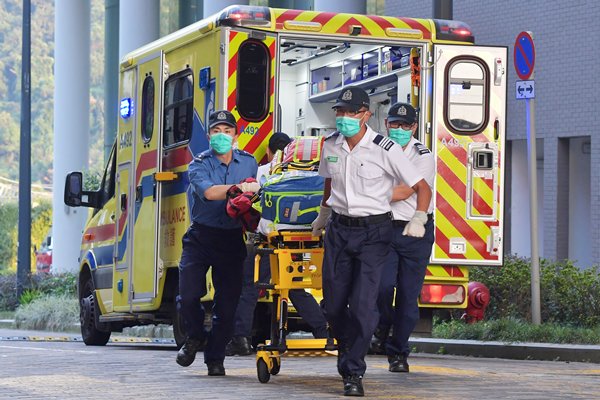
The ambulance service has been part of the Fire Services Department since 1919 and its mobile ambulance technology is keeping pace with the evolution of technology in hospitals.
To aid ambulance crews in the race against time to save lives, the department installed automatic chest compression machines in all ambulances in October.
The advanced device helps medics respond to a cardiac arrest by delivering uninterrupted compressions at the right rhythm and the right amount of pressure.
Fire & Ambulance Services Academy Deputy Commandant (Ambulance Services Training) Terence Ng explained that the device enables paramedics to treat patients on their way to the hospital.
“It has other advantages as well, like reducing the compression pause significantly, lowering the risk of injuries suffered by ambulance personnel as a result of performing chest compressions in different environments, allowing ambulance personnel to perform chest compression continuously in a constrained environment, and releasing more ambulance manpower to carry out other treatment procedures.”
Keeping pace
Such advanced equipment was not available to ambulance crews in the past.
Retired Principal Ambulanceman Simon Wong and Assistant Chief Ambulance Officer Conrad Yung visited the Fire & Ambulance Services Education Centre & Museum to discover the century-long history of ambulance services in the city.
Both have witnessed the continuous improvement and development of equipment, knowledge and techniques of ambulance personnel.
Mr Wong joined the Fire Services Department as an ambulanceman in 1978 and retired after 34 years of service. He noted one of the major changes to the department was the implementation of the Paramedic Ambulance Service in 2005.
“When I joined the department, we were well trained to provide ambulance services. We would arrive at the scene and then transport the patient to the hospital as soon as possible. We rarely provided pre-hospital treatment. However, when I retired, there was an obvious change. Ambulance personnel now provide paramedic care for patients in ambulances.”
Mr Ng said the service provides medications and equipment to help improve the survival rate of emergency patients.
“Advanced treatments like airway insertion and defibrillation used to be confined to the hospital. However, paramedics brought them into pre-hospital settings. Paramedics administer advanced treatments and protocols to the patient at the scene or en route to hospital in order to stabilise the patient and increase the patient’s survival rate. This protocol allows ambulance personnel to treat a wide range of emergencies, including cardiac arrest, shortness of breath and cardiac origin chest pain.”
Mr Yung, who joined the Fire Services Department in 1960, noted that treatment methods have come a long way since then.
“I was an ambulanceman when typhoon Wanda hit Hong Kong in 1962. At that time, ambulances were only equipped with respiratory equipment, a medicine box and blankets. These tools are simple but important. But in the past, even though we knew that a patient had internal bleeding, we could not do anything to help. We did not have the tools and equipment for that.”
Ambulances these days are equipped with ultrasound scanners to detect internal bleeding.
Up-close look
The Fire & Ambulance Services Education Centre & Museum, housed inside the Fire & Ambulance Services Academy in Tseung Kwan O, has a four-story exhibition hall offering interactive and multimedia information facilities.
Visitors can get a close-up look at fire appliances and ambulances parked in the large exhibition areas, as well as uniforms and equipment.
The venue is open for group and individual visits which can be booked on its website.
Building Smarter, Faster In Hong Kong
Facing a chronic labour shortage and soaring construction costs, Hong Kong’s infrastructure sector is turning to adv... Read more
Media Interns Take Stage In Hunan
Navigating career options amid rapid transformation in the media industry presents a tough choice for communication st... Read more
District Governance: Estate Upgrades Put Focus On Well-being
On a hot summer’s day, elderly residents sit chatting under the shade of some large trees – a simple scene of comm... Read more
CM Hospital To Offer Targeted Care
Several years ago, Mr Lai suffered a mini-stroke that turned his daily life into a constant battle against physical di... Read more
Supporting Startups On Tech Frontier
Tech executive Fan Yi-chen commutes from his home in Shenzhen for his job at the Hong Kong-Shenzhen Innovation & T... Read more